Now that you have had a chance to think about tax systems:
- Which type do you prefer – progressive, flat tax, income, consumption – and why?
- How do you think the concept of equity or fairness fits into a tax system – if at all?
- How about incentives?
- Former President Trump says the last tax bill caused structural changes in the economy that would lead to more growth. What do you think? Can you find any data to support your view?
I prefer a progressive tax on income, coupled with some tax on consumption, and only a few deductions. It seems to be that it is more fair to tax everyone the same percentage at all income levels, like a flat tax. This would mean that whether you make $25,000/year, $100,000/year, or $500,000/year if everyone was charged the same 25% tax rate at all income levels, that means the following tax revenue would be collected from income:
- $25,000/year x 25% = $6,250 tax
- $100,000/year x 25% = $25,000 tax
- $500,000/year x 25% = $125,000 tax
If you went with our USA 2021 brackets and charged a progressive rate, the tax revenue looks more like this:
- $25,000/year = $2,800 tax (average tax rate 11.2%)
- $100,000/year = $18,020 tax (average tax rate 18%)
- $500,000/year = $148,548 tax (average tax rate 29.7%)
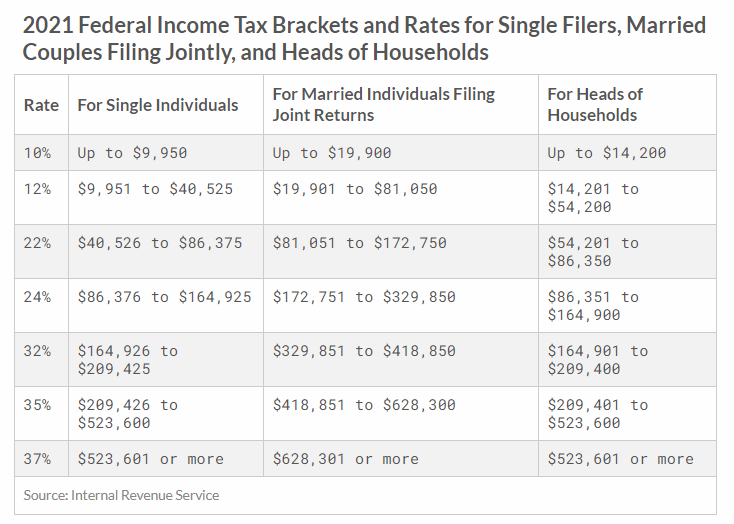
If you think about someone making that upper level of $500,000/year being taxed more in a progressive system, you are only losing a difference of $23,548 from the flat tax 25%. This small change wouldn’t change behavior of a high income earner at all, and generates additional income for the government to use.
You could increase the savings rate, as well as increase home ownership, increase healthy lifestyles, and improve moral for high earners and low to middle income earners alike.
Equity and fairness fit into the tax system the way it is laid out today as our tax system is progressive. Some say this discourages those that earn more income per year, as the tax rates go up the more you earn. Also, when you make more money toward the top you are incentivized to find ways to hide your income from the government by using tax loopholes, or even tax shelters out of the country. As I showed in the flat tax example above, the small amount of a flat tax vs progressive won’t change behavior at the top levels.
If I think about the lower end of the earners in our country, it would be hard to make only $20,000/year and then have to pay a flat tax 25%. This income level would barely be able to live in most areas of our country so having the lower brackets pay less in taxes probably makes the most sense. You want to provide incentives to promote education and skill building to help create more opportunities for low income earners.
I don’t believe anything former president Trump said. He has proven to be a pathological liar, bigot, and cheat. He has failed projects left and right in real estate and used the bankruptcy laws repeatedly to cheat the system. He mislead our country heading into the covid pandemic and should be held responsible for the misinformation he helped to spread about the virus, and the vaccines. He is partially responsible for the fragile state of America’s economy today.
With regards to the effects of his tax policy, I believe in a more fair tax percentage across income brackets, but there are many articles online that show that the very rich upper levels of the tax brackets don’t need more tax breaks. They don’t tend to spend that money in our country anyways, as most luxury goods are foreign and most luxury vacations are foreign. The more tax breaks you give to the upper levels, the more money flows out of the country. If you think about the top tax bracket as income earning over $500,000/year – that is a lot of money to make in 1 year. These are executives at companies, small business owners, and entrepreneurs.
I agree with Trump for boosting the standard deduction which takes away some deadweight loss as it makes tax preparation easier and quicker because less people need to itemize.
According to the CBO and other estimates, the Trump tax cuts will not pay for themselves, as they are estimated to short tax revenue. Time will tell to show us how much permanent impact they will have. Here is a good website to learn more about Promises mostly NOT Kept.
https://news.bloombergtax.com/daily-tax-report/the-trump-tax-cuts-promises-made-promises-kept-1

